
Space & Beyond
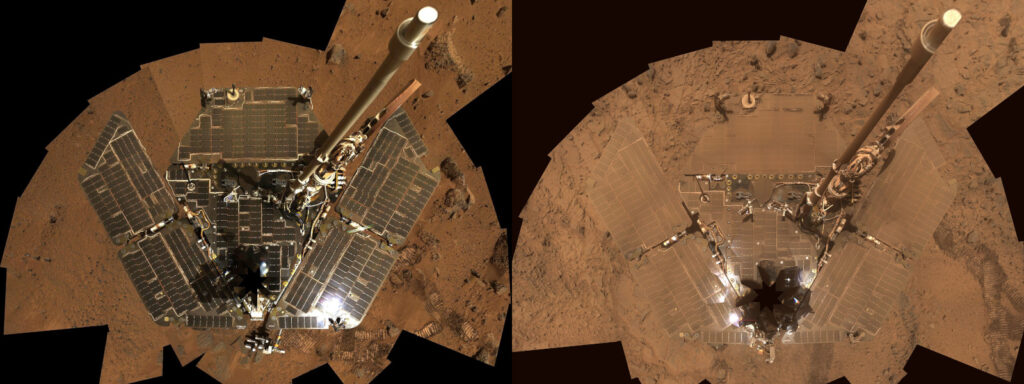
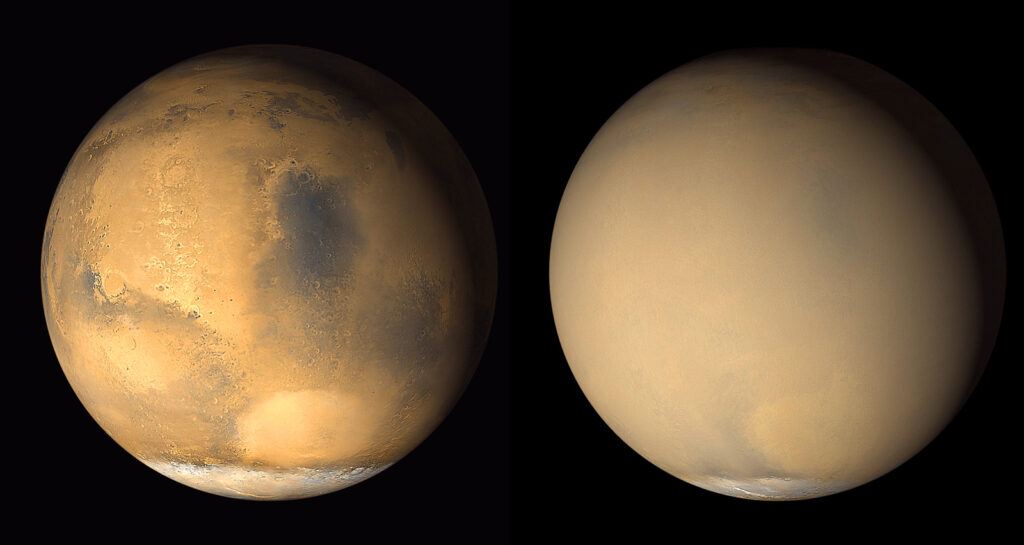
Dust accumulation is one of the most persistent operational constraints for solar-powered systems in space exploration — and one of the least solved. On Mars, progressive soiling and dust storms reduced available solar power, constrained rover operations, and contributed to mission-ending energy shortages.
The principles that define the AIr™ airflow cleaning method — non-contact operation, zero liquid dependency, and autonomous sensor-based alignment — align directly with the constraints of space-adjacent and extraterrestrial environments where conventional cleaning is impossible.
(photo: NASA/JPL-Caltech/ASU/MSSS)
Ingenuity and the Aerial Precedent
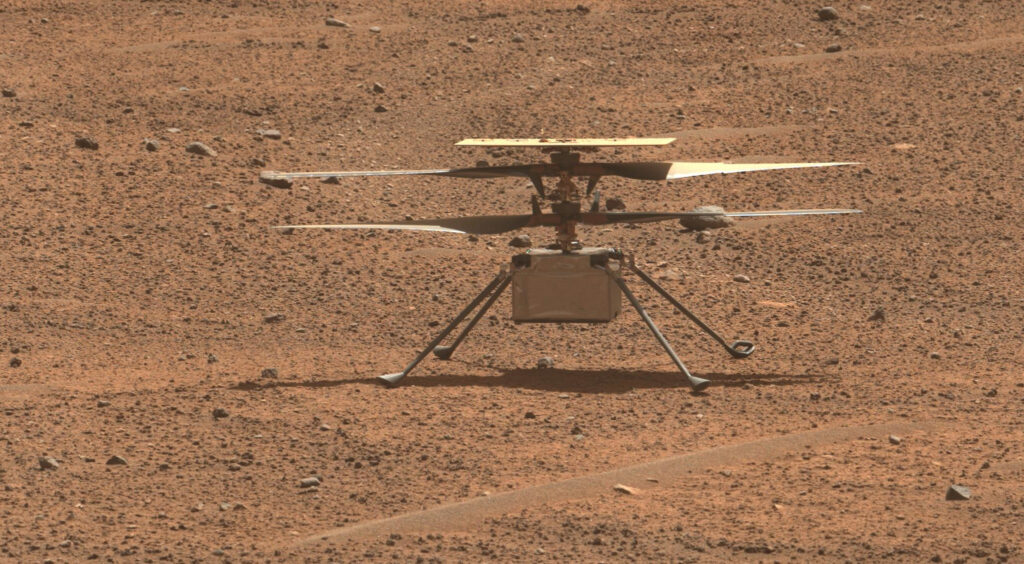
NASA’s Ingenuity helicopter, deployed with the Perseverance rover in February 2021, demonstrated that autonomous aerial vehicles can operate in the thin Martian atmosphere.
Ingenuity is solar-powered, lightweight, and designed for repeated autonomous flight — the same operational profile that defines AIr™-compatible platforms on Earth. Its success establishes both the technical feasibility and the mission relevance of lightweight autonomous aerial systems for Mars surface operations.
Lessons from Mars
NASA’s solar-powered Mars missions provide the clearest documented evidence of what unmanaged dust accumulation costs at a mission level:
- Sojourner (1997)
Solar-cell performance declined progressively during the mission as dust accumulated on the rover. - Spirit (2004–2010)
The mission ended after severe dust-related power constraints and environmental conditions prevented the rover from sustaining operations. - Opportunity (2004–2019)
Survived nearly 15 years — significantly beyond its 90-day design life — aided in part by periodic wind events that cleared panel surfaces. The mission ultimately ended following an unpredictable major dust storm that produced irreversible soiling.
The Opportunity mission is particularly instructive. Its extended lifespan was partly attributable to passive airflow events removing accumulated dust — demonstrating that airflow-based panel clearing works under Martian atmospheric conditions. The limitation was that those events were unpredictable and passive. An active, autonomous airflow system addresses precisely that gap.
Conceptual Applications
AIr™ has explored the application of drone airflow cleaning principles to space-adjacent and extraterrestrial environments as a forward-looking extension of the patented method. Potential mission-relevant applications include:
Solar Panel Maintenance for Rovers
Autonomous airflow cleaning of rover solar panels would provide consistent energy output during long-duration missions, reducing the operational dependency on unpredictable passive wind events that characterized the Opportunity mission profile.
Stationary Solar Array Maintenance
Future crewed Mars installations and research stations will likely rely on fixed solar arrays for base power generation. Regular autonomous cleaning cycles would maintain output without manual intervention, water, or chemical processes — all of which are either unavailable or prohibitively costly in an extraterrestrial context.
Instrument and Sensor Surface Maintenance
Beyond solar panels, dust accumulation degrades the performance of cameras, atmospheric sensors, spectrometers, and navigation systems. Precision airflow clearing of sensitive instrument surfaces extends functional lifespan and reduces mission risk.
Low-Gravity Adaptability
The sub-250g platform profile of AIr™-compatible drones is directly relevant to mass-constrained mission architectures. Lightweight, non-contact, zero-liquid operation aligns with the core constraints of both planetary surface missions and orbital maintenance concepts.
NASA’s Dragonfly rotorcraft mission (2028 launch, Titan arrival 2034) will expose its science instruments and navigation sensors to Titan’s organic aerosol and hydrocarbon particulate environment — a maintenance challenge where autonomous airflow-based sensor clearing is directly applicable.
From Mars to Earth
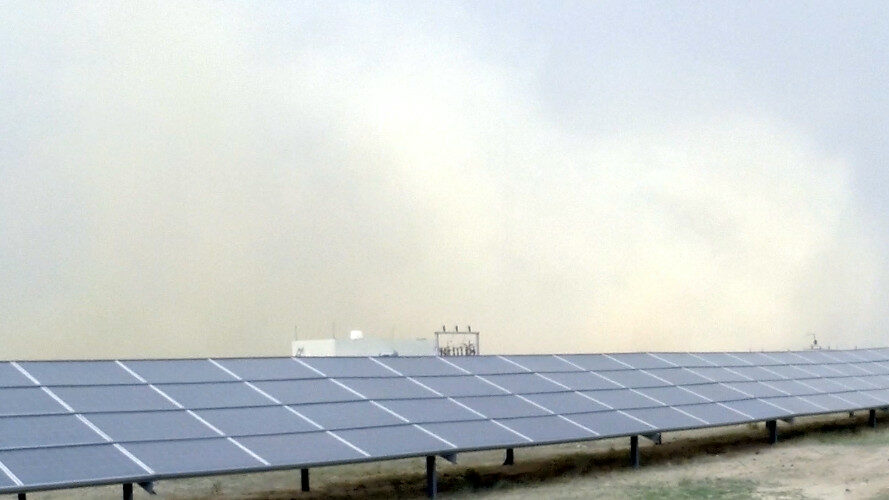
The dust management challenges that ended Spirit and extended Opportunity’s life are not unique to Mars. Solar farms in the Sahara, Rajasthan, the Atacama, and the Arabian Peninsula face the same progressive soiling dynamic under similar atmospheric conditions — and the same absence of on-site water and manual labor infrastructure.
The AIr™ method was developed for terrestrial arid environments first, but the underlying physics, operational constraints, and design requirements are directly shared with space exploration applications.
“Our mission is to reduce operation and maintenance costs for solar energy while increasing panel profitability. By using drone cleaning technology, we aim to decrease the frequency of manual wet cleans, making solar energy more accessible and efficient — even in marginal areas.” — Ridha Azaiz, Inventor, AIr™.
The AIr™ method patent covers autonomous sensor-based airflow cleaning across environments and surface types. For space agencies, aerospace contractors, and research institutions exploring dust management for solar-powered extraterrestrial systems, licensing and co-development discussions are open.