
Dust accumulation on solar PV panels is one of the most operationally significant and underserved maintenance challenges in utility-scale energy. In arid and dust-prone regions, soiling can materially reduce output and increase maintenance burden, while cleaning frequency, water use, and labor requirements can make module cleaning a significant share of O&M cost.
AIr™ addresses this directly through solar panel drone cleaning — a patented, non-contact, waterless airflow cleaning method that operates without mechanical contact, water supply, or panel modification.
A study by King Fahd University of Petroleum and Minerals (KFUPM) demonstrated that the downward thrust of a drone cruising over PV panels successfully removed accumulated sandstorm dust, restoring panel current by up to 61.2% without physical contact.
The Case for Airflow Cleaning
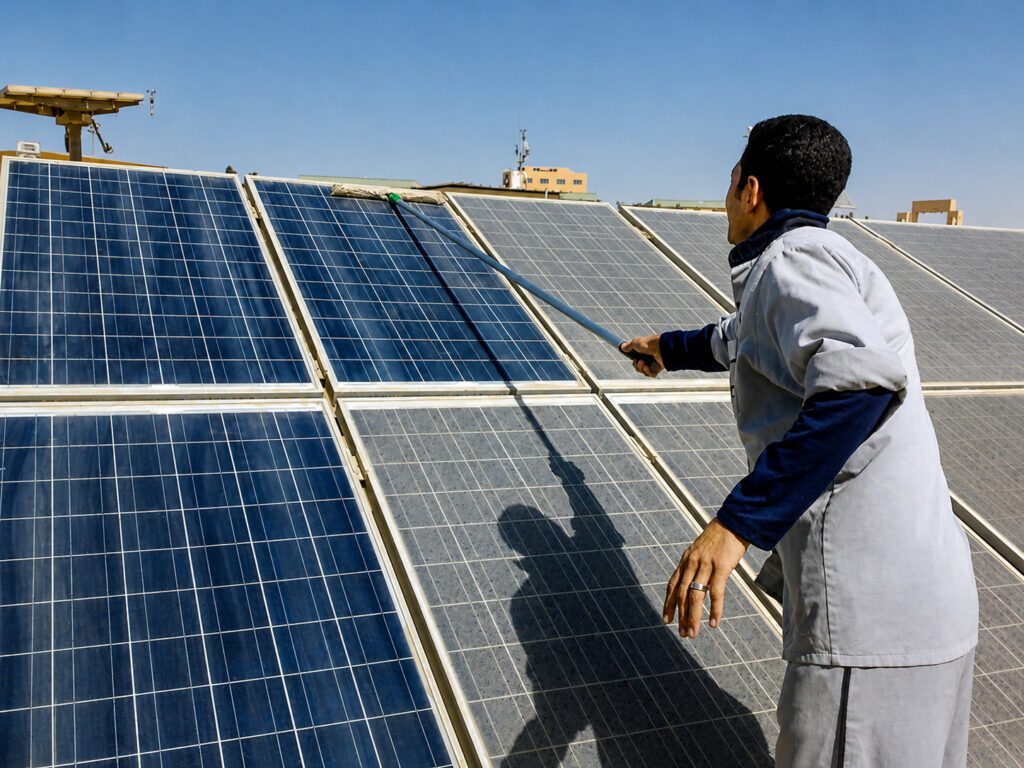
Traditional cleaning approaches — manual crews, robotic brush systems, or water-spray vehicles — carry significant operational costs and risks in solar environments:
- Manual cleaning is subject to human error, including micro-crack formation from thermal shock when water at the wrong temperature contacts heated panel glass.
- Brush and wheel-based robotic systems risk abrasion of anti-reflective coatings, potentially voiding panel warranties.
- Water-based methods require transport logistics, chemical treatment, and are increasingly restricted in water-scarce markets.
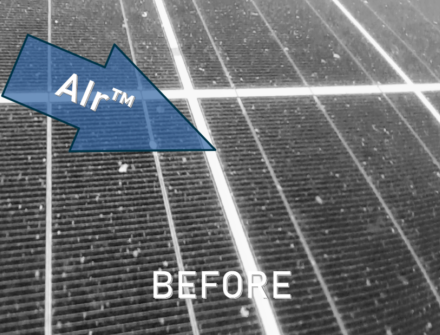
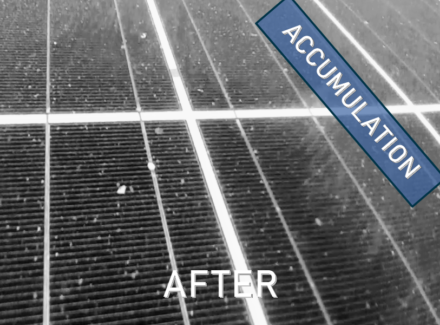
By delivering autonomous solar panel drone cleaning through controlled rotor downwash, the patented method maintains panel output without physical contact, water consumption, or hardware customization for individual panel configurations.
Operational Advantages
Zero water consumption:
critical for arid and semi-arid deployments where water transport represents a major cost centre.
No contact, no abrasion:
non-contact operation preserves anti-reflective coatings and maintains panel warranties.
Sub-250g platform compatibility:
AIr™-equipped drones can remain below the critical 250-gram regulatory threshold, reducing permitting complexity for remote and utility-scale sites.
Scalable fleet deployment:
airflow beam coverage and flight path optimization allow a small number of drones to maintain large arrays with minimal operator oversight.
Preventive frequency:
regular low-intensity cleaning prevents surface encrustation that requires more aggressive and damaging intervention to reverse.
Remote operability: drone-based systems are easily transported and deployed at sites where permanent infrastructure is unavailable.
Target Environments
AIr™ is particularly well suited for utility-scale solar installations in environments where conventional methods are operationally constrained:
Desert and arid regions:
Rajasthan, Sahara, Atacama, Mojave, Gobi, Arabian Peninsula.
Agrivoltaic and dual-use arrays:
where ground access is restricted to prevent crop damage.
Remote off-grid installations:
sites without access to water supply or permanent maintenance crews.
Heritage and sensitive sites:
where water runoff or chemical use creates environmental or regulatory risk.