
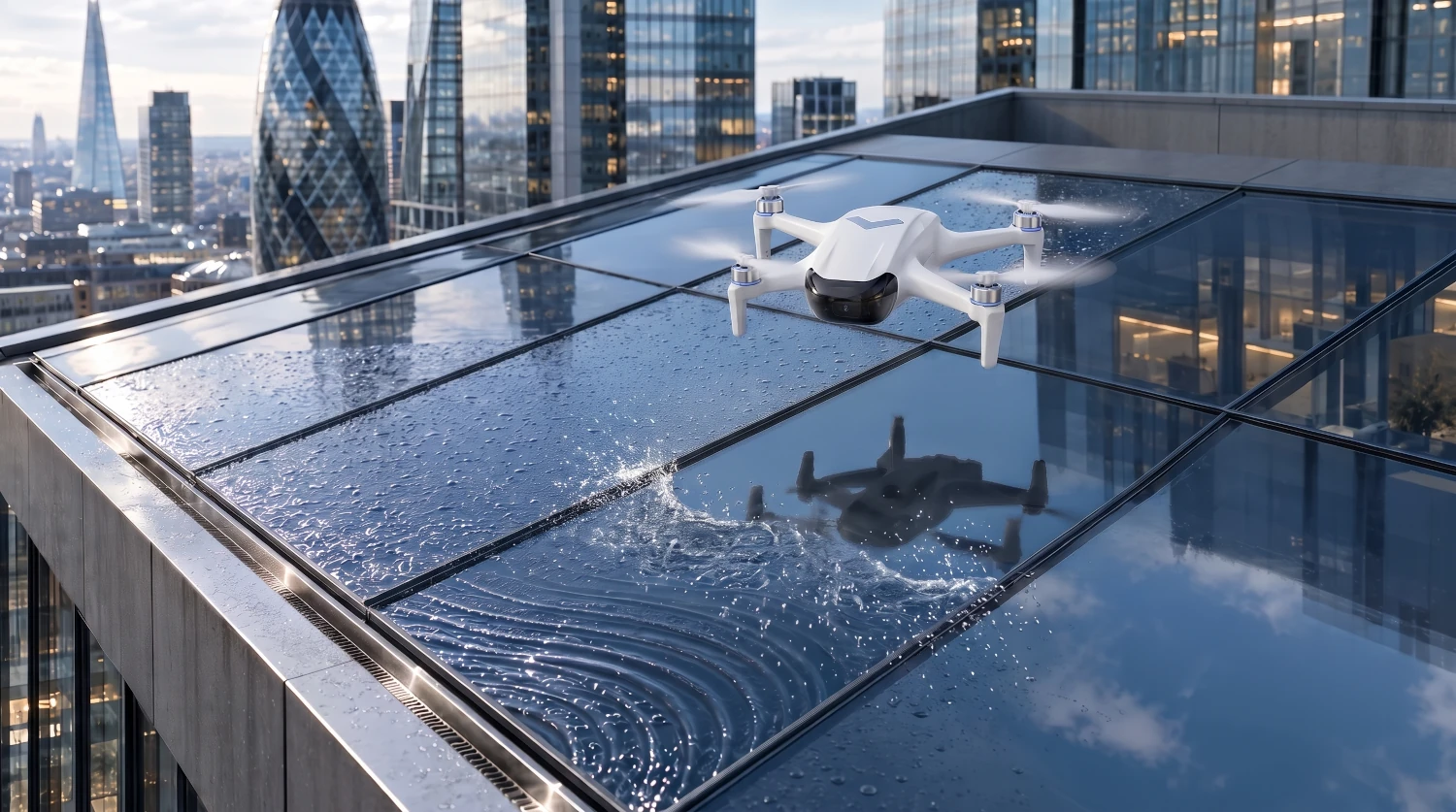
Water-Washing & Hybrid Spray Drones
Liquid-spraying cleaning drones, whether tethered to ground pumps or carrying onboard tanks, do not operate in still air. Where a multirotor hovers or translates at close, sensor-regulated proximity to wash solar arrays, roofs, greenhouses, or building facades, its spray plume operates directly inside the aircraft’s own high-energy aerodynamic wake.
The AIr™ patent family protects the foundational method of using onboard sensors to align a flying vehicle with a target surface and harness aircraft-generated airflow as an active cleaning mechanism, operating both in zero-water dry passes and in hybrid fluid-assisted configurations where airflow drives droplets, collimates spray, and shears away residual water.
Sensor-Guided Standoff as the Enabling Layer
Spraying a structure from the air requires holding a consistent working distance in turbulent near-wall airflow while counteracting hose weight, wind gusts, and nozzle reaction forces. Manual line-of-sight piloting alone can lead to uneven coverage, overspray drift, or airframe contact.
By fusing onboard distance and positioning sensors, including millimetre-wave radar, LiDAR, laser rangefinders, ultrasonic sensors, or visual SLAM, autonomous flight-control routines lock relative standoff, heading alignment, and subdivided pass spacing. That sensor-locked proximity places the target surface squarely within the coupled multiphase zone where rotor wake and applied liquid interact.
Multiphase Execution Modes
Across commercial airframes and payload architectures, aircraft airflow can contribute directly to liquid-assisted surface cleaning across five operational regimes:
Centrifugal Spinning-Disc (CDA) & Tank Mist Transport
Untethered tank drones equipped with Controlled Droplet Application (CDA) rotary atomisers or low-pressure misting booms shed fine droplets radially with near-zero downward hydraulic pressure. Lacking ballistic momentum of their own, these low-inertia droplets lock onto the aircraft’s merged downward rotor slipstream, which provides convective transport onto tilted solar panels or greenhouse roofs and spreads the resulting liquid film across the glass.
Hose-Fed Fan Jets, Aerated Foam & Air-Sheathed Nozzles
Across a non-contact standoff gap, wide-angle liquid sheets rapidly break up into discrete atomised droplets that decelerate in air, while low-density soft-wash foams and passive Venturi air-inducing shrouds lose forward velocity shortly after leaving the nozzle. Simultaneously, the multirotor’s wake expands across the spray zone, shielding mist and foam from crosswind drift, channelling air-guided jets, and propelling droplets into surface recesses.
Vertical Facade Proximity, Recoil & Wall-Effect Flow
Discharging a pressurised horizontal spray lance generates continuous backward reaction thrust alongside downward umbilical hose tension, requiring the flight controller to pitch nose-in toward the building to hold a sensor-locked standoff. While that forward pitch tilts the primary slipstream centerline slightly away from the wall, operating at close sensor-regulated proximity places the front rotors and spray zone inside a confined near-wall aerodynamic regime:
turbulent wake expansion, wall-side inflow recirculation, and impingement across ledges, sills, and glazing recesses generate boundary-layer shear that entrains mist and accelerates downward water-film drainage—often paired with air-sheathed nozzles that project a protective air stream directly along the liquid jet.
Two-Stage Dry Pre-Clearance & Wet Rinse
On roofs, canopies, and heavily soiled arrays, running a dry rotor-airflow pass with liquid flow switched off clears loose pine needles, leaf litter, and coarse sand first, allowing a lighter deionised rinse or soft-wash pass to lift bonded pollen, sap, or salt films without turning loose debris into mud.
Mid-Pass Shear & Active Water-Film Removal
Both during wet passes (as the rotor wake sweeps across the wetted swath) and in dedicated pump-off finishing passes, tangential boundary-layer shear thins and strips standing water, suds, or melted de-icing slush from panes, ledges, and frames before slow evaporation can trap airborne dust or refreeze.
Trading Destructive Pressure for Aerodynamic Shear
Harnessing the rotor wake fundamentally improves the fluid mechanics and asset safety of wet aerial cleaning:
- Lower hydraulic impact stress: Continuous tangential wall-jet shear helps mobilise loosened films across horizontal and tilted surfaces without relying solely on aggressive bar pressure, reducing the risk of thermal shock, micro-cracks, seal blowouts, and anti-reflective coating damage.
- Reduced water and chemical volume: Because airflow suppresses crosswind plume loss and actively spreads thin liquid films across the glass, fewer litres per square metre are required to achieve uniform wetting and rinsing.
- Streak-free finish in dusty climates: Immediately shearing away residual rinse water prevents evaporative spotting and stops wet glass from acting as an adhesive trap for windblown sand.
- Lower power draw & extended battery flight time: Moderating hydraulic pressure and flow reduces both pump power consumption and backward nozzle recoil, requiring less pitch-compensation thrust, allowing lighter low-pressure hoses, minimising turbulent wall-rebound buffeting, and preserving onboard battery endurance on untethered flights.
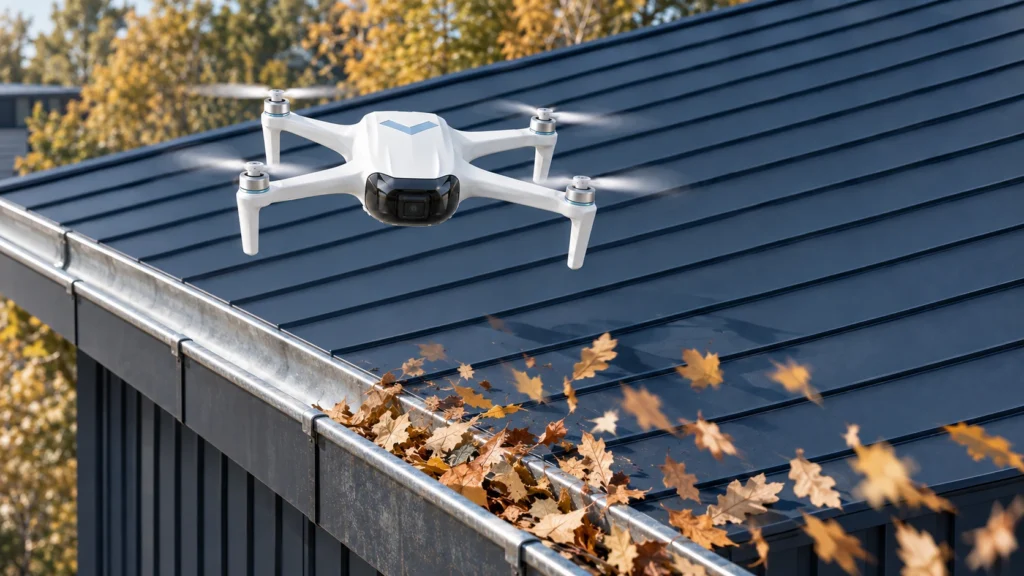
Coupled AIr™ Operation vs. Uncoupled Spraying
Attempting to spray surfaces from a drone without sensor-guided aerodynamic coupling introduces compounding operational penalties:
Stagnant re-soiling: Without near-wall aerodynamic shear to strip the rinse film, standing water pools along lower frame edges and re-cements airborne particulates as it dries.
Far-field plume dispersion: Hovering far enough away that rotor airflow no longer interacts with the spray or surface causes atomised droplets and foam to decelerate in air and scatter in light crosswinds, wasting purified water and treatment solutions.
High-pressure compensation risk: Overcoming a wide uncoupled air gap forces operators toward narrower, higher-pressure jets, draining onboard battery endurance, amplifying backward recoil instability and increasing mechanical stress on fragile roof tiles, coatings, and glazing joints.
Patent Scope in Spraying Drones
In the granted AIr™ patent family (including EP3077882B1 and international counterparts), the specification expressly describes detecting surface distance and geometry using radar, laser, infrared, ultrasonic, or optical sensors, and performing surface cleaning using rotor-generated airflow alone and/or in combination with a mounted effector or cleaning head (including automated path-subdivision routines for a cleaning head in dependent claims).
Where a tethered hose-fed or tank-based spray drone combines sensor-based surface alignment with aircraft airflow that materially contributes to droplet transport, plume collimation, pre-clearance, or residual water-film removal, the operation may fall within the scope of protection in jurisdictions where the patent is in force, subject to a claim-by-claim assessment.