
The Problem Wind Leaves Behind
Rotor downwash can remove bulk, loose and mechanically mobilisable dust without water or surface contact. With Ionised AIr™, a second layer is addressed: fine particles that are no longer governed mainly by gravity or ordinary mechanical displacement.
Below roughly 30 micrometres, surface forces become increasingly important. Van der Waals attraction, electrostatic effects, humidity history, contact geometry and particle-particle cohesion can allow fine material to remain attached even after larger dust has been cleared.
The result can be a residual fine film: visually subtle, optically significant and harder to remove by airflow alone. Ionised AIr™ is designed for that gap.
Ions generated on or near a rotor-equipped platform are entrained in the drone’s own downwash and delivered to the surface as part of the same working medium that already performs cleaning.
The rotor downwash does two things at once: it carries ions toward the particle-surface interface, and it provides the aerodynamic shear to mobilise and clear material once adhesion has been modified.
Delivered ions may reduce charge-sensitive adhesion enough for the rotor flow already present to cross a removal threshold it previously could not reach. Bipolar ion delivery allows the architecture to operate across mixed or unknown dust charge states without assuming a single favourable polarity.
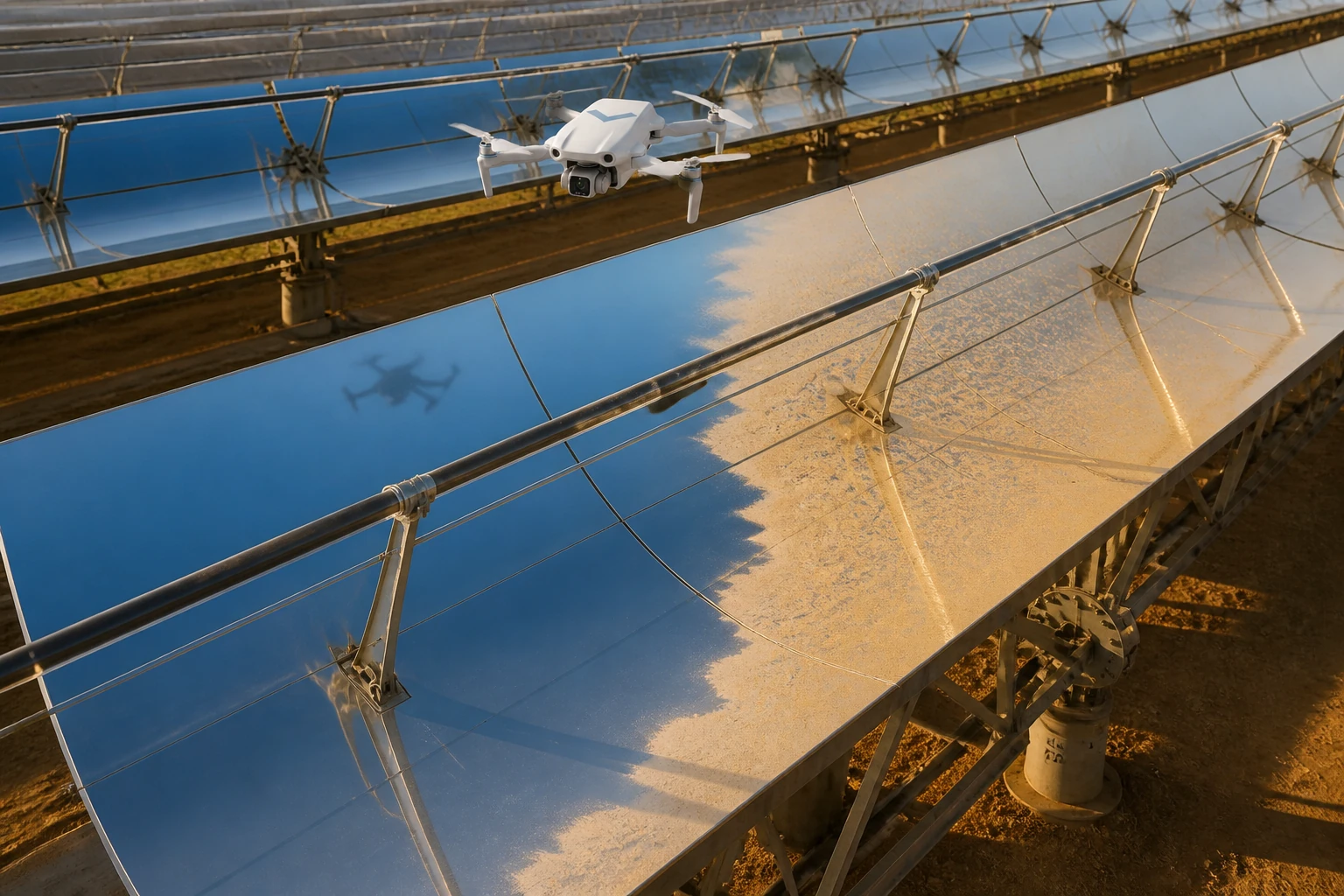
Where It Applies
The same charge-sensitive adhesion that can limit airflow-only cleaning on PV glass may also occur wherever fine mineral dust, aerosols or surface films accumulate on exposed infrastructure in arid, high-particulate environments.
Desert solar and CSP
Fine residue persisting after wind, brushing or airflow cleaning in water-scarce markets.
Heliostats and CSP mirrors
Fine optical haze on reflective surfaces where contact cleaning carries operational and abrasion risk.
Greenhouse glass and film
Aerosol, dust and biological residues that may survive bulk cleaning passes.
Sensor surfaces and instrument optics
Field environments where fine-film degradation is mission-critical.
Extraterrestrial surfaces
Electrostatically active fine dust in low-gravity, zero-liquid, non-contact environments.
Intellectual Property
Building on the foundation of the patented AIr™ method, including US10,046,857B2 and international counterparts, the Ionised AIr™ architecture and its integrations are covered by a dedicated family of patent applications as well.
Ionised AIr™ is currently advancing through empirical validation. We are open to research collaborations with university laboratories, solar O&M operators, and test facility partners, as well as licensing discussions with parties developing next-generation dry cleaning systems.
→ Read the scientific paper
→ Back to the AIr™ Method